
Powder activated carbon
Powder
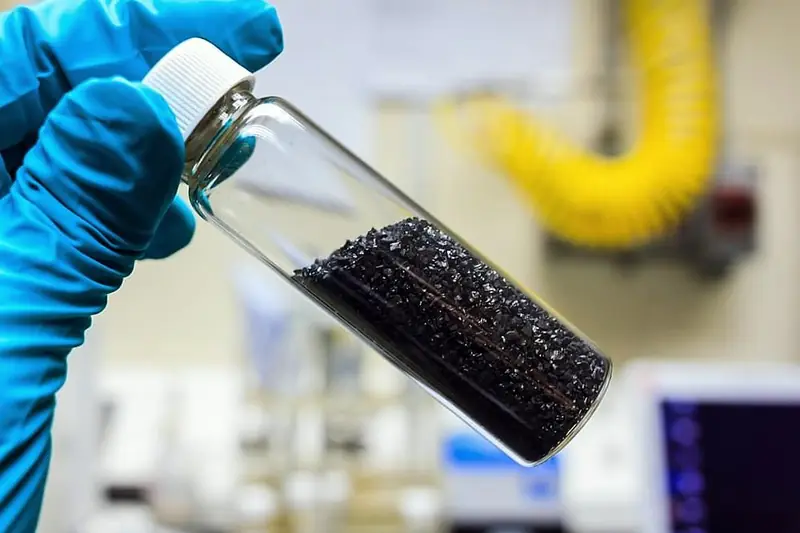
Steam-activated wood carbon, milled fine. Works fast in water, oils, syrups and chemicals.
- Raw material
- Babul (Acacia nilotica) wood
- Particle size
- -100, -200 or -325 mesh
- Iodine number (ASTM, JIS)
- 800 to 1,200 mg/g
Data sheet (PDF)Formal technical data sheet (PDF)Company brochure (PDF)
Powder activated carbon (PAC) is dosed straight into a tank or a stream, mixed, and filtered out again. Its fine particles reach equilibrium in minutes, so it works where a fixed bed would be too slow or too costly, and the dose can follow a changing load.
Our main powder is made from Babul (Acacia nilotica) wood and activated with steam. Wood gives a carbon rich in mesopores, the 2 to 50 nanometre pores that take up large molecules such as colour bodies, humic matter and many pesticides. That makes it a strong choice for municipal water, effluent, edible oil and sugar decolorization, and API purification.
Decolorizing edible oil
- Dark oil in the bleaching tank
- A small dose of wood powder carbon goes in
- Mixed, then filtered out in a filter press
- Light, clear oil comes out
Used for
- Municipal water: taste, odour and micropollutants
- Effluent colour, COD and organics
- Edible oil, sugar and glucose decolorization
- APIs, intermediates and fine chemicals
- Blending into pellets for higher CTC
Typical figures
| Raw material | Babul (Acacia nilotica) wood |
|---|---|
| Particle size | -100, -200 or -325 mesh |
| Iodine number (ASTM, JIS) | 800 to 1,200 mg/g |
| Methylene blue (BIS) | 170 to 320 mg/g |
| Methylene blue (JIS) | 150 to 200 ml/g |
| Moisture | below 5% |
| Ash | below 10% |
| pH | 9 to 11 |
| Bulk density | 0.35 to 0.50 g/cm³ |
| Packing | 20 or 25 kg bags, jumbo bags |
Figures are typical. We confirm the figures for your order with the quote.
How to order
- Packing
- 20 or 25 kg bags, or jumbo bags
- Shipping
- By container from India
- Samples
- A sample for your own tests before you order
- Test reports
- A test report with every lot
How every lot is tested
- A sample is taken from every lot
- Iodine number: how much it can adsorb
- Methylene blue: how it takes larger molecules
- Hardness, ash and moisture go on the report